Nifty 50 TRI · Verified data · 2018–2026
₹0
What stopping a ₹5,000/month SIP during COVID actually cost one investor over six years. Not projected. Measured.
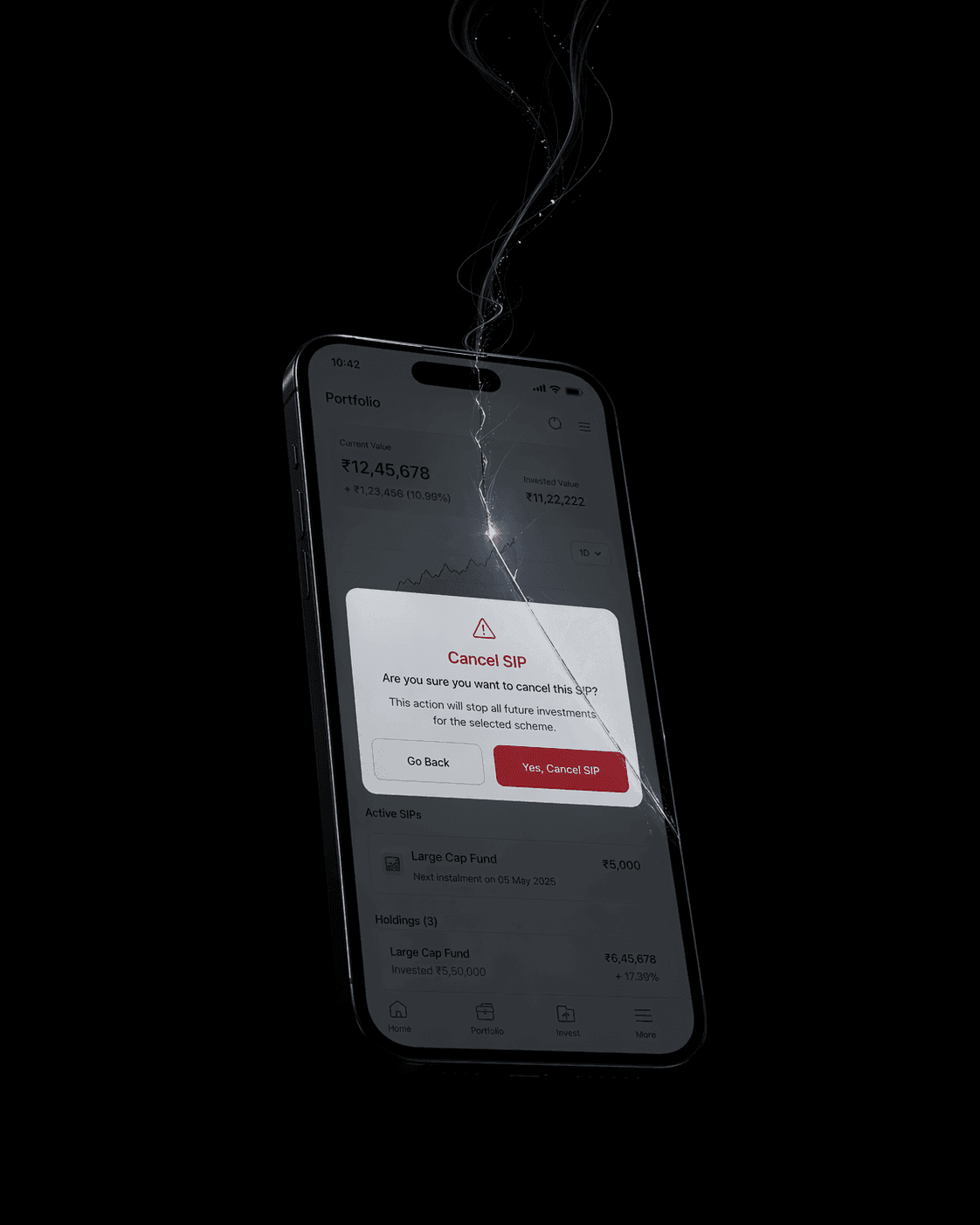
Beat I — Forty-Five Seconds
Open the app. Tap the portfolio icon. Scroll to "SIPs." Find the one you want to stop. Tap the three dots on the right. Tap "Cancel SIP." A popup will ask if you are sure. Tap "Confirm." A dropdown will ask why. Select "Other." Close the app.
Forty-five seconds. Somewhere between checking a WhatsApp group and deciding what to order for dinner.
We built a simulation to find out what that sequence costs. The model is simple: take an investor running a ₹5,000-a-month SIP, have them cancel mid-correction, redeem all accumulated units, and move the money into a savings account. Then compare their wealth, year by year, against an investor who kept going and a third person who never invested in equity at all.
We ran it using the Nifty 50 Total Return Index: actual daily index values, actual SIP dates, actual SBI fixed deposit rates.
For the COVID crash, the modeled cost of stopping came to ₹1,38,897 over six years. That is twenty-eight months of the SIP itself.
Beat II — The Scale
In January 2025, 61.33 lakh SIPs were discontinued or reached the end of their tenure. In the same month, 56.19 lakh new ones were started. The SIP base in India, which had grown almost without interruption for a decade, shrank.
Above 100% = more SIPs stopped than started
"My first instinct was to pause my SIPs for a while until things calm down." Every word is reasonable. The cost is not in the reasoning. The cost is in the time horizon the reasoning assumes.
Beat III — What Happened
The trigger was a correction.
On September 27, 2024, the Nifty 50 index touched 26,277, an all-time high. By March 4, 2025, it had fallen to 21,964. A decline of 16.4% spread across five months.
The correction itself, measured against the last two decades of Nifty data, was well within the range of previous episodes. Drawdowns of 10% or more have occurred roughly seven times since 2008, with an average duration of about five months. But ordinary is a word that only works in retrospect. Inside the correction, five months feels like a permanent state of affairs.
Beat IV — The Experiment
Three investors. Same ₹5,000. Different choices.
The keeper invests ₹5,000 on the first trading day of every month through April 2026. The stopper invests for three months, redeems all units near the correction's trough, then puts ₹5,000/month into a savings account at 3.5% annual interest. The FD investor never touches equity: ₹5,000/month into SBI term deposits, interest taxed at 30%.
Correction 1 of 3
2024–25 Correction
18 months · 19 installments
Stopper is ahead by ₹1,859 today. At historical growth rates, the keeper overtakes around July 2026.
Final wealth · 18 months · 19 installments
The stopper finished behind someone who never touched equity.
Eighteen months in, the stopper is ahead by ₹1,859. If this correction were the only evidence in the dataset, the forty-five seconds would look like a perfectly good use of time. This correction is not the only evidence in the dataset.
Correction 2 of 3
COVID Crash
6 years 3 months · 76 installments
The keeper was never behind. Not for a single month.
Final wealth · 6 years 3 months · 76 installments
The stopper finished behind someone who never touched equity.
Correction 3 of 3
NBFC Crisis
7 years 8 months · 93 installments
Stopper ahead for 4 months. Keeper ahead for 70 months and counting.
Final wealth · 7 years 8 months · 93 installments
The stopper finished behind someone who never touched equity.
In every completed correction, the stopper finished last.
Not just behind the keeper. Behind the person who never invested in equity at all. The stopper took the risk, paid the cost of the crash, then left before collecting the reward.
| Kept going | FD only | Stopped | Gap | |
|---|---|---|---|---|
| 2024–25 Correction | ₹94,715 | ₹98,592 | ₹96,574 | -₹1,859 |
| COVID Crash | ₹5.5L | ₹4.4L | ₹4.1L | +₹1.4L |
| NBFC Crisis | ₹7.5L | ₹5.5L | ₹5.3L | +₹2.2L |
The crash did not cost you money. Stopping did.
The 2024-25 correction is still unresolved. The stopper is ahead today. But every past correction told the same story: stopping feels rational for a moment. Then compounding decides.
India spent a decade building the infrastructure to help ten crore people start investing. Whether the infrastructure to help them stay invested through a routine correction is adequate is a question worth asking, and one that the next correction will answer whether the industry has prepared for it or not.
Methodology & data sources
Market data — Nifty 50 TRI daily values via niftyindices.com. 5,278 trading days, Jan 2005-Apr 2026. TRI includes dividend reinvestment.
SIP simulation — Keeper: ₹5,000 on first trading day monthly. Stopper: 3 months, then full redemption around 1 month later, then ₹5,000/month into a 3.5% savings account.
FD — ₹5,000/month at prevailing SBI 1-year rates. Interest taxed at 30%.
Data journalism. Not investment advice. Past performance does not guarantee future results.