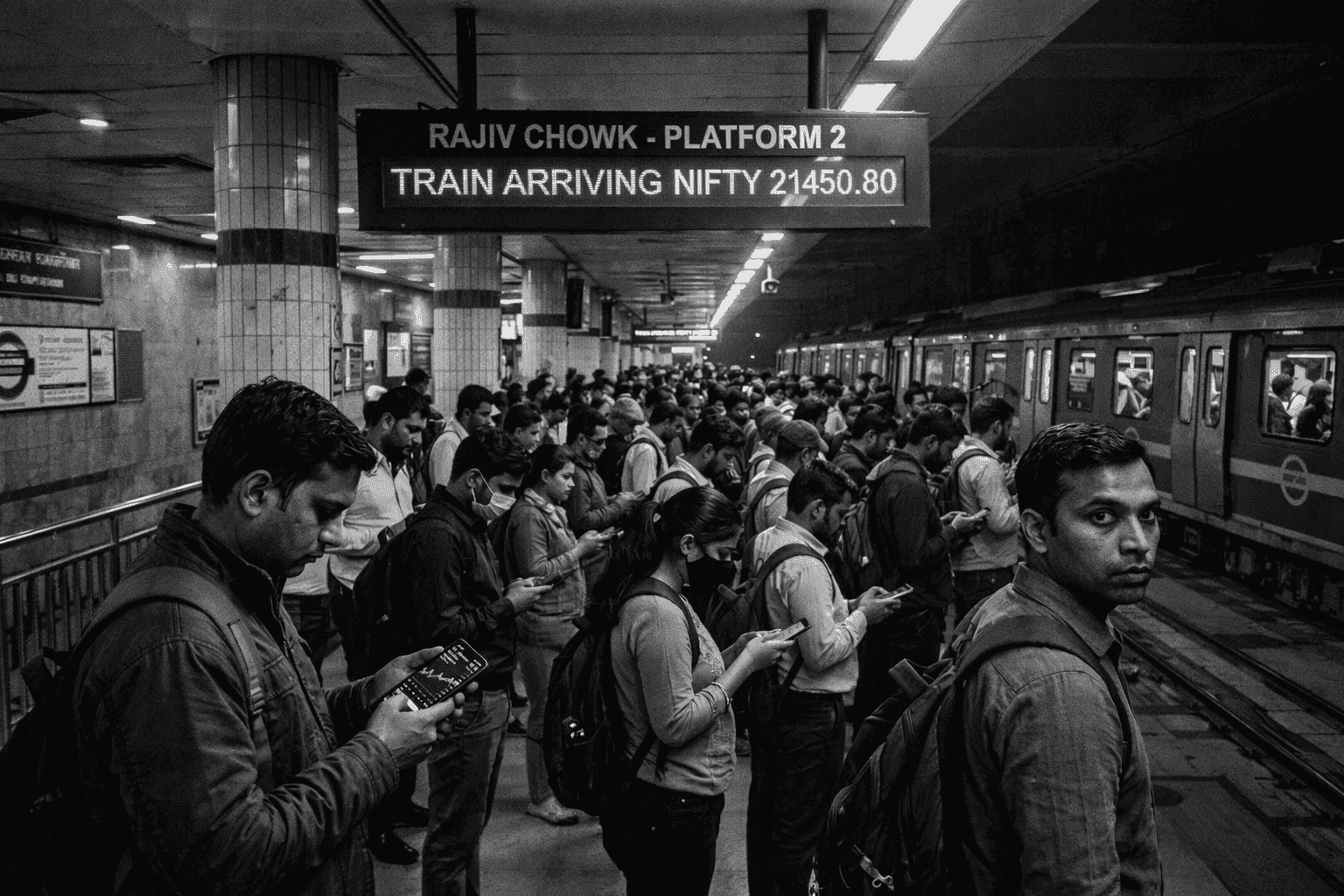
When SEBI published the number, it was not a surprise to anyone who had been paying attention, but it was the first time a regulator had said it in a form that could not be argued with. Ninety-one percent of individual traders in India's equity futures and options market lost money in FY2024. Across 9.6 million active retail accounts, the aggregate net loss was Rs 75,000 crore. On the other side of those trades, proprietary trading firms running strategies that were 96% algorithmic earned Rs 33,000 crore. One percent of retail traders earned profits exceeding Rs 1 lakh after costs.
I was in the ninety-one percent. I had spent three years learning market profile, orderflow, footprint charts, delta analysis, and auction market theory under a genuinely profitable trader in a Telegram group. I could draw volume profiles and read order-flow imbalances in real time. I knew more about the microstructure of the Nifty index than most professionals I've met since. None of it was enough.
The reason it was not enough has very little to do with skill.
A far out-of-the-money Nifty weekly call option costs Rs 5 to Rs 15 per unit, with a lot size of 75 units, which means your entry runs from Rs 375 to Rs 1,125. The contract expires in four days. For it to pay, the underlying index has to move far enough, fast enough, in the right direction. If it doesn't, the premium decays toward zero, steadily, through time, without the kind of drama that would make you close the position early. But while time is working against the buyer, several other participants have already been paid, regardless of what the index does.
Zerodha charged Rs 20 the moment you entered the trade. The exchange took its transaction fees. Before your order was even confirmed, the market maker had already captured the bid-ask spread. Then the tax layers: GST on brokerage and exchange fees, Securities Transaction Tax on the sale, stamp duty, and SEBI's own regulatory fee on top. In FY2024, SEBI calculated that individual retail F&O traders spent Rs 22,451 crore on transaction costs alone, broken across Rs 11,364 crore in brokerage, Rs 4,469 crore in exchange fees, Rs 3,454 crore in STT, Rs 2,868 crore in GST, Rs 199 crore in stamp duty, Rs 97 crore in SEBI fees. The average retail trader spent Rs 26,000 on transaction costs that year, more than half of which was brokerage.
Every participant in this chain gets paid by activity, not by outcome. The broker earns whether you win or lose. So does the exchange. So does the government. The market maker earns the spread regardless. The only person in the transaction whose financial result depends on being right about the direction of the index is the person buying the option.
This would matter less if the distribution system that delivers retail traders to the product were built around education. It is built around acquisition. Most traders never understood the referral arrangements underneath the platforms they traded on. Brokers like Angel One share 50 to 70 percent of brokerage revenue with their referral partners, for the lifetime of the account. Upstox shares 30 to 50 percent. A referral partner with ten thousand active F&O accounts could earn crores annually from their audience's trading activity, whether that audience was profitable or not. The Telegram groups and YouTube channels that present themselves as trading education are, if you look at the revenue side, lead generation for brokerages. The learning is incidental to the referral relationship. What gets monetised is the trading, not the education.
SEBI knew this was happening before it published the number. The regulator mandated popup warnings in mid-2023, effective from October 1 that year. Before a trader could enter an F&O position, a popup appeared stating that nine out of ten retail traders lose money. The popup was clear, factual, and based on SEBI's own data.
In the months that followed, demat accounts continued to open at record pace. Premium turnover climbed back to pre-intervention levels.
The behavioral science on this is not ambiguous. A 2021 systematic review covering eighteen studies on gambling popup warnings found moderate short-term effects on cognition and behaviour, though the variation across study designs was wide enough that the aggregate hides more than it reveals. The FCA commissioned its own work on financial product warnings; the redesigned versions improved comprehension of risk but produced no reliable shift in what people actually did with their money. A separate meta-study the FCA cited went further, concluding that disclosure remedies, risk warnings included, often have no measurable effect on consumer action. The tobacco warning literature tells a version of the same story: pictorial warnings beat text-only warnings on attention and stated quit intentions, but even those results apply to intermediate outcomes, not sustained behavioral change.
What this research shares, if you read it as a body rather than citation by citation, is a finding about who warnings work on. They work best when the person receiving them does not already believe they have an edge. The difficulty in trading is that preparation creates exactly that belief. I had done three years of real study. The popup was not written for me, or so I had decided, without quite articulating it, long before it appeared. The framework I'd been taught had an answer for every outcome. Losses meant position sizing was wrong. Wins meant the methodology was working. The system couldn't be disproved on its own terms, which meant I couldn't leave it on its own terms either. What the preparation actually did was not protect me from the market. It insulated me from the warning.
SEBI's persistence data, published alongside the headline loss rate, is the part that should disturb anyone who believes warnings and education are sufficient. Seventy-five percent of loss-making traders continued trading despite consecutive years of losses. Eighty-eight percent of those with three or more years of experience were still losing, with an average annual loss of Rs 1.5 lakh. These were not new accounts clicking through their first popup. These were people who had absorbed every warning the system could offer and returned anyway.
In October 2024, SEBI stopped relying on warnings and redesigned the product itself.
The circular implemented six measures, rolled out between November 2024 and April 2025. Minimum contract sizes for index derivatives tripled, from a value range of Rs 5-10 lakh to Rs 15-20 lakh. Weekly options expiries were restricted to one benchmark index per exchange, which killed the daily expiry cycle that had become the primary arena for retail speculation. Upfront collection of option premiums became mandatory. Calendar-spread margin benefits were removed on expiry day. An additional two percent extreme loss margin was levied on short options expiring that day. Intraday position-limit monitoring with at least four random snapshots per day began in April 2025.
Volume collapsed. Monthly equity options contracts on NSE and BSE fell from 16.1 billion in October 2024 to 3.6 billion in February 2025, a 78 percent contraction in four months. Unique individual equity derivatives traders declined from 61.4 lakh in Q1 FY2025 to 42.7 lakh in Q4 FY2025. The global ripple was measurable: the Futures Industry Association reported that global exchange-traded derivatives volume fell 42.5 percent in Q1 2025, and India's intervention was the primary driver.
The contracts then partially recovered. By January 2026, monthly options contracts had climbed back to 7.2 billion, and premium turnover had returned to Rs 20,032 crore daily. The intervention did not kill the market. It compressed it and then allowed a smaller, higher-ticket version to re-expand.
Whether the intervention reduced losses is a harder question, and the first year's data is not encouraging. SEBI's FY2025 study, published in July 2025, found that 91 percent of individual equity derivatives traders still lost money, the same rate as FY2024. The aggregate net loss was Rs 1,05,603 crore, up from Rs 75,000 crore the year before, in a market where fewer people traded. The product changed shape. The losses, at least in the first post-intervention year, did not.
India is not the only jurisdiction that has produced this kind of data. But the global picture is less symmetrical than most coverage suggests, and the asymmetry is instructive.
SEBI published the richest study: individual-level, multi-year, with transaction-cost decomposition, persistence tracking, and counterparty identification. No other regulator has gone as deep. In Europe, ESMA went further in one specific respect: since 2018, every CFD provider regulated in the EU must calculate the percentage of its retail client accounts that lost money over the previous twelve months, update the figure quarterly, and display it in a standardized risk warning on its own website. You can visit IG and see 68 percent. CMC Markets, 68 percent. FxPro, 85 percent. Plus500, 77 percent. The UK's FCA made the same requirement permanent and estimated that its CFD intervention measures would save retail consumers GBP 267 to 451 million per year. Australia's ASIC measured CFD losses, intervened, and found that average quarterly net losses fell 91 percent in the six months following its product intervention.
Taiwan, South Korea, and Brazil have produced aggregate evidence through academic research using exchange or regulator data. The Taiwan paper is Barber, Lee, Liu, and Odean, who found that individual investor trading losses equaled 2.2 percent of GDP (a number that, when I first read it, I assumed was a typo). In Brazil, Chague, De-Losso, and Giovannetti found that among day traders who persisted more than 300 days in equity-index futures, 97 percent lost money. These are academic papers, not ongoing disclosure systems, but they confirm that the finding replicates across market structures and cultures.
Then there is the United States, and this is where the gap becomes difficult to explain as anything other than a choice.
The US already runs a broker-level loss-rate disclosure system for one class of retail derivatives, and it has been running since 2010. Under CFTC Regulation 5.5(e), every retail foreign-exchange dealer and futures commission merchant that offers OTC forex to retail customers must calculate the percentage of non-discretionary retail forex accounts that were profitable and not-profitable, update the figure quarterly, maintain the calculations for five years, and disclose them to prospective customers. Interactive Brokers' Q4 2025 disclosure shows 43.93 percent profitable and 56.07 percent not-profitable. The system works. The data is published. The infrastructure has been in place for fifteen years.
Listed options are not covered. FINRA Rule 2360(b)(20) requires brokers to retain records that permit supervisory review of options account activity, including profit or loss in each account. This is a record-retention requirement for compliance purposes, not a mandate to compute or publish aggregate statistics. The data exists at broker level, inside every firm's compliance system, on every trading day. No SEC commissioner has requested the aggregate, and no FINRA notice has proposed extending the CFTC's forex model to options. The OCC publishes nothing on retail-level P&L. The infrastructure to produce the number is built, funded, and already collecting. The number has not been produced.
Meanwhile, US listed options volume is on track to exceed 13.8 billion contracts in 2025, a sixth consecutive annual record. Average daily volume through September 2025 was 59 million contracts, up 22 percent from the prior year. Zero-days-to-expiry options account for 57 percent of SPX index options volume. Retail traders' share of short-dated options has risen from roughly 35 percent to 56 percent. Researchers at the University of Münster, working with trade-level data from OPRA, estimated that retail traders lost approximately $350,000 per day on 0DTE options after daily expirations launched in May 2022. A Journal of Finance study found that retail investors favour cheaper weekly options with average bid-ask spreads of 12.6 percent and that, in aggregate, retail options trades lose money. Cboe, which operates the exchange where most of this activity occurs, published a paper in 2024 disputing the methodology and estimating positive but statistically insignificant customer P&L. The paper was produced by Cboe's own research team about Cboe's own product.
Citadel Securities paid $2.6 billion for retail order flow in 2020-2021, $1.7 billion of it in options, according to a compilation of SEC Rule 606 disclosures by The TRADE. When a firm pays $1.7 billion to fill your options orders, it is not doing so because the arrangement benefits you.
The asymmetry across jurisdictions is now sharp enough to state plainly. India counted, published, warned, redesigned the product, and continues to measure. Europe requires every CFD broker to display its own loss rate, updated quarterly, on its own website. The United States requires the same disclosure for retail forex. For listed options, where retail participation is larger, growing faster, and concentrated in the shortest-dated contracts most stacked against retail, it requires nothing.
Extending the CFTC's retail forex disclosure model to listed options would not require new legislation, new infrastructure, or new data collection. It would require FINRA or the SEC to mandate that brokers compute and publish the same figure for options accounts that the CFTC already requires for forex accounts: the percentage of non-discretionary retail accounts that were profitable and not-profitable over each quarter, disclosed before account approval, updated quarterly, maintained for five years.
The objection will be complexity: that options outcomes depend on strategy, holding period, and portfolio context in ways that make a single profit/loss figure misleading. That objection is not wrong. But it applies equally to forex, where the CFTC requires the disclosure anyway, because the regulator judged that an imperfect number visible to the public beats a perfect number locked inside compliance files.
India ran the experiment. The number did not fix the problem by itself, but it made the problem visible, and visibility made intervention possible. The popup alone was not enough. The product redesign alone was not enough to change the loss rate in the first year. But India at least built the feedback loop: count, then publish, then warn, then redesign, then measure what happened. The United States has not entered that loop. It has not started counting.
The data sits inside every brokerage's compliance system, retained under rules the regulators themselves wrote. The disclosure system for publishing it has been operating for retail forex since 2010. Nobody has applied it to options. Why not?