I. THE REWIRING
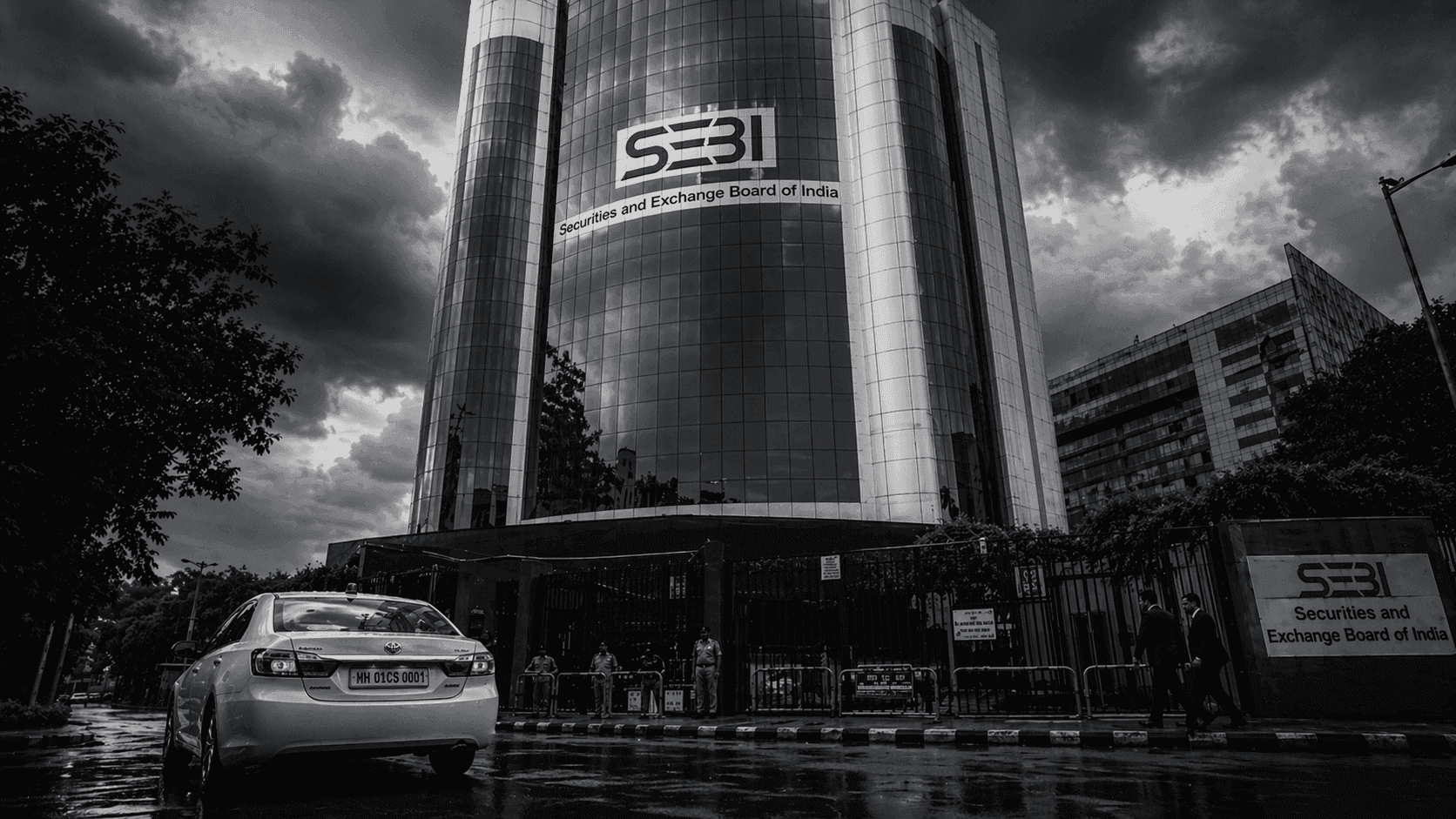
In October 2024, SEBI redesigned India's index derivatives market.
Bank Nifty weekly options turnover fell from Rs 23,700 crore to Rs 4,300 crore. Down 82 percent.
82%
Bank Nifty weekly options turnover collapse · Oct 2024 Rs 4,843cr
Amount impounded · Jane Street interim order
Nifty Financial Services fell from Rs 6,000 crore to Rs 111 crore. Down 98 percent. Nifty Midcap fell from Rs 4,400 crore to Rs 747 crore. Down 83 percent.
Nifty 50 weekly options rose from Rs 20,000 crore to Rs 52,500 crore. Up 162 percent.
Total premium turnover across all index options: roughly the same.
Close three lanes on a highway and traffic doesn't disappear. It squeezes into the lane you left open. That's what happened here. SEBI cancelled weekly expiries on four indices and left one standing. Traders moved to the room that was still open.
The market didn't shrink. It concentrated.
This is called market design. The regulator decides what products exist, at what sizes, on what schedule. Then everyone adjusts. SEBI didn't ban derivatives trading. It changed the architecture so that the same activity now happens in a different shape, with different contract sizes, for different participants.
There was process. A consultation paper was issued in July 2024. Six thousand people submitted comments. A circular followed in October, with phased implementation through February 2025.
But notice what the process did not require.
SEBI did not have to name a mechanism. The consultation paper said weekly expiries led to "hyperactive trading" and "increased volatility." It did not say why weekly expiries cause harm that monthly expiries would not.
SEBI did not have to explain why disclosure failed. For years, brokers had been required to show popups warning that 93 percent of traders lose money. If the warnings were working, why was product redesign necessary? The consultation paper did not say.
SEBI did not have to commit to a threshold for success. The reforms were permanent unless SEBI chose otherwise.
The reasoning came after. The commitment never.
Now consider what happens when SEBI penalizes a single broker.
The Securities Markets Code Bill 2025 says enforcement orders must be "proportionate to the default or contravention committed." That's Section 19. There are hearings. There are appeals. SEBI must specify the violation.
For market design, the standard is different. Section 11 says SEBI may regulate "by such measures as it may deem fit." Section 40 says SEBI can direct stock exchanges to change their bye-laws if it considers it "necessary or expedient."
To punish one person: proportionate.
To redesign a market for millions: fit.
The narrower the intervention, the higher the burden. The broader the intervention, the lower the burden. This is exactly backwards.
II. WHY DISCLOSURE WASN'T ENOUGH
SEBI's original theory was simple. Tell people the odds. Let them decide.
The disclosure regime that followed was extensive. Brokers were required to display warnings: "9 out of 10 individual traders in the equity F&O segment incurred net losses." SEBI published the underlying studies, with methodology, so anyone could check the numbers. The data showed 1.13 crore individual traders over three years, 93 percent with net losses, aggregate losses of Rs 1.8 lakh crore.
The information was public. The warnings were mandatory. The acknowledgment was required.
It didn't work.
SEBI's own study proved this. The same research that established the 93 percent loss rate also found that 75 percent of traders who lost money in one year returned to trade the following year. They had seen the warnings. They had clicked acknowledge. They came back.
Consider the architecture of a weekly index option in its final hours. A Bank Nifty call option ninety minutes before expiry might cost Rs 15 to Rs 50 per unit. At 25 units per lot, that's Rs 375 to Rs 1,250 per trade. The premium feels like nothing because, in isolation, it is nothing.
But the structure invites repetition. A small loss Monday. A small loss Wednesday. A win Thursday that feels like validation. The cumulative damage happens below the threshold of attention.
Disclosure assumes a person weighing information before making a decision. But when the ticket costs less than lunch, when the time horizon is shorter than a meeting, disclosure is intervening at the wrong level.
III. ONE MARKET, TWO BURDENS
In July 2025, SEBI issued an interim order against Jane Street, the American trading firm. The allegation was systematic index manipulation. The amount impounded was Rs 4,843 crore.
In October 2024, SEBI issued a circular redesigning the index derivatives market. The stated concern was retail losses. The market affected included 9.6 million individual traders.
Same regulator. Same broad time period. Same market segment. Two completely different regulatory approaches.
The Jane Street order ran to 105 pages. It specified dates, times, and trade sequences. Jane Street can contest every allegation. The burden on SEBI is forensic.
The F&O reforms specified what SEBI changed. What they don't specify is the causal theory connecting product architecture to retail harm, at a level that could later be tested.
This is the asymmetry: the narrower the intervention, the higher the evidentiary burden. The broader the intervention, the lower the burden.
IV. CONSULTATION IS NOT COMMITMENT
SEBI consults. It publishes papers, receives comments, issues circulars. This is not nothing.
But consultation is not commitment.
A commitment is a statement made before acting that can be checked after. The terms are fixed in advance. They can be tested against outcomes.
Compare this to monetary policy. After 2016, the Reserve Bank of India operates under an explicit inflation target — 4 percent, with a tolerance band of ±2 percent. If inflation falls outside this band for three consecutive quarters, the RBI Governor must write to the Central Government explaining why.
This is ex ante commitment. The target is named in advance. The threshold for explanation is specified. The accountability is automatic.
SEBI has no equivalent for market design.
V. BEFORE YOU REWIRE
Before any market-wide product redesign, SEBI should publish a Market Design Notice — not a consultation paper that invites input, but a commitment document that binds the regulator to a testable theory.
Four elements. First, the market failure: which type SEBI believes exists — externality, information asymmetry, market power, or public good. Second, the mechanism: how the specific design feature causes the specific harm. Third, the alternatives: why lighter tools are inadequate. Fourth, the review rule: what evidence would count as success, and when the intervention will be revisited.
The Code already knows how to require ex ante impact consideration. Section 128 governs the regulatory sandbox, and requires SEBI to "consider the impact of the proposed product, contract or service on the systemic stability of the securities markets." For an experiment with a new product in a controlled setting, the Code requires impact consideration. For a permanent change to a live market where millions already trade, it requires only that SEBI deem the change fit.
If impact consideration is appropriate before testing something new, it is appropriate before redesigning something that already exists at scale.
VI. THE HARDER QUESTION
The hard question is this: what if a product is dangerous even when users understand it?
One view says no. The Ajay Shah tradition holds that losses from voluntary risk-taking are not regulatory failures. People understood the product. They accepted the risk. They lost. Casinos have worse odds, and we let them operate.
The other view says yes. A product architecture that systematically transfers wealth from less sophisticated participants to more sophisticated ones has externality-like features. It damages household savings. It damages trust in financial markets. These effects extend beyond the individual traders.
The honest answer is that this essay does not resolve the question. But here is what a Market Design Notice would do: it would force SEBI to take a position. It should name the externality. It should own the paternalism, if paternalism is what it is.
Right now, SEBI gets to act without declaring which theory it believes. That ambiguity is comfortable for the regulator. It is not good for the institution.
VII. CLOSE
India does not need SEBI to stop designing markets. Markets require architecture. Someone has to decide what can be traded, at what sizes, on what schedule. That someone is SEBI.
The question is not whether SEBI should have this power. It should. The question is what disciplines the exercise of it.
Closing the gap does not require SEBI to stop acting. It requires SEBI to commit before acting. To say what it believes is broken, through what mechanism, and how it will know if the fix worked.
Before you rewire a market, say what you think is broken. Say why your fix addresses it. Say how you will know if you were wrong.
That is not a burden. That is the job.